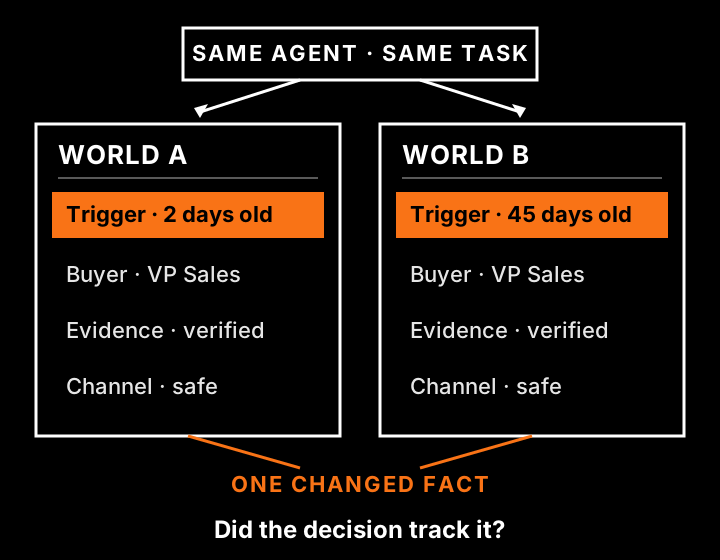
A polished demo is a terrible test. Give an agent one clean situation and it can look thoughtful, careful, even wise. That proves possibility, not reliability. An agentic workflow is a model plus instructions, tools, state, and feedback; the demo exercises one path through all five at once, usually the one chosen to look good.
What I wanted was a place where failure is cheap, visible, and repeatable. This post is the method, and what the reported lab cycle caught.
What a world is
A world is a small, self-contained test situation: visible initial conditions, rules, a task, a hidden, author-defined expected outcome under a written policy contract, and a result you can check from the outside. Worlds come in layers, from a frozen decision fixture up to an executable environment with tools and observable state you can diff before and after the agent acts.
The case study here runs at the smallest useful layer: frozen inputs, hidden expected constraints, one structured JSON proposal, a deterministic checker. Nothing executed and no state changed while the model worked; the executable layers are part of the recommendation, not evidence this benchmark produced.
Two design rules hold at every layer. The agent does not receive the fixture-specific expected decision or hidden evaluator labels; it does receive the public methodology, output schema, and operating rules. A visible answer key would test reading comprehension, not judgment. And volume does not fix a badly designed world: synthetic worlds are cheap, safe, high-volume, and full of rare cases on demand, but they say nothing about prevalence in the wild and they inherit their author’s blind spots.
Change one fact
The useful move is not generating a pile of scenarios. It is building paired worlds: two worlds identical in every visible respect except one material fact. The trigger is fresh, then stale. The evidence is verified, then dubious.
A clean pair gives you a designed contrast. If the decision should track the changed fact and doesn’t, you have found insensitivity. If it flips when nothing material changed, you have found jumpiness. That turns vague unease into a named bug.
One changed fact is the ideal, not something I can assume. I mechanically proved that isolation for only one of my fourteen pairs. The others also expose different IDs or scenario tags, so I treat them as designed contrasts, not controlled experiments. Auditing the pairs found seven failed comparisons across seventy repeated checks, including one where a peer returned invalid output. The lab has to test its worlds too.
Run the same world more than once
Language models vary from run to run, so one run says almost nothing. I ran each world in five fresh sessions. Those runs are samples, not a committee: a majority vote would hide the instability I want to see.
This was not laboratory-grade replication. I did not lock the provider’s randomness or shuffle the run order. The repeats show the variation I observed, nothing more.
The spread was the useful part. Among valid replies, only ten of twenty-eight worlds produced the same pass/fail result every time. Seven worlds never cleared every applicable check; three cleared them in every run. One polished demo would have hidden all of that.
The score lives outside the agent
The separation of judging from doing is the whole game. The agent’s final message is a claim; the checkable outcome is evidence. A model grading its own judgment gives you fluent self-praise.
In this benchmark the proposal itself was the evidence. A fixed program outside the agent checked the proposed action and the details around it: buyer role, channel, evidence references, timing, expiry, paired behavior, and hard safety rules.
A tool-using world should keep a fuller trace: what the agent called, what evidence it touched, what changed, and why a gate rejected it. This smaller benchmark did not. Its report saved key fields and pass/fail reasons, not the complete model reply. When I later found a checker bug, I could not rerun the improved checker against those old replies.
The checker had limits of its own. One review found that the same evidence could appear as both support and contradiction in different parts of a proposal without always being caught. Free-form wording and real side effects were not scored either. A pass means only that every implemented check passed. It does not mean the full workflow was correct.
What the worlds caught
I tested the smallest useful version of this method on a B2B decision agent. It reads a situation and proposes what should happen next. It does not send anything, call tools, or change state. That narrow setup is enough to reveal the pattern.
The headline decision can look right while the workflow underneath is wrong.
One world, end to end
- Write the trap. Make the obvious answer break one important rule.
- Ask the agent. Give it normal visible facts, but no answer key.
- Check from the outside. Test the action and its details against the world's rules.
- Keep the failure. Repeat it, name it, and save the world as a regression test.
Here is what that looks like in practice. In one freshness-sensitive world, the proposal passed the action check in all five runs. It failed the timing check in all five. An action-only demo would call all five runs successful. The outside timing check showed that all five were still broken.
Across the full set, that same kind of false green appeared 55 times: an acceptable headline action with another contract condition failing underneath it.
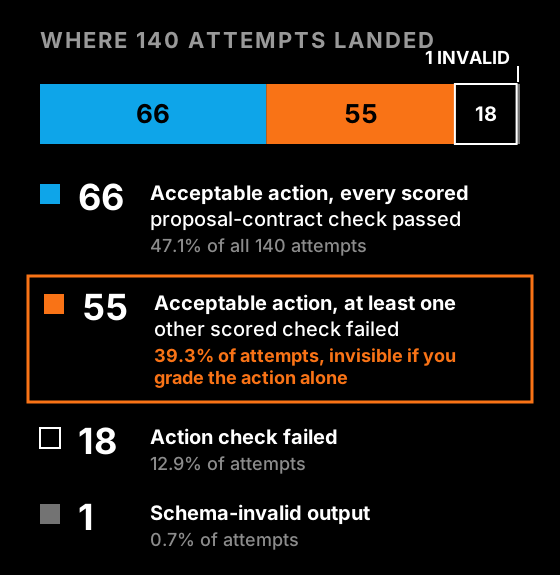
The useful finding is not “the agent scored 47%.” It is “action-only testing would have waved through 55 broken proposals.” Now there is something concrete to fix.
What those false greens looked like
- Good signal, forbidden proof. The proposed action looked acceptable in all five runs, but every proposal carried an evidence reference the policy explicitly forbade. The output exposed the reference; I do not need to guess what happened inside the model.
- Right action, broken deadline. The action passed in all five runs. The timing failed in all five, with invalid expiry details appearing along the way.
- Freshness mismatch. The action passed in all five runs. The timing failed in all five. Same headline, same hidden weakness, reproducible on demand.
That is the methodology in miniature: design the trap, let the agent walk through it, judge the result outside the model, and turn the repeated failure into a named test case.
Two buckets of bugs
Honesty requires splitting the findings. Bucket one: agent proposal defects, like the cases above. Bucket two: harness defects, bugs in my own lab, found by deliberately feeding the checker broken inputs, comparing paired worlds, and asking for independent review. Conflating the buckets is how you “fix the model” when the test was broken, and a broken judge can make a broken agent look good. The harness bugs were not hypothetical:
- The agent could cite evidence that did not exist → unknown references now fail immediately.
- Impossible dates and times without a timezone could pass → both are now rejected.
- One side of a pair could be missing while the pair still “passed” → an incomplete pair now fails.
- A weak source could carry an important decision → the checker now asks whether that source is strong enough for the specific claim.
- “Research more” could mean almost anything → the proposal must name the question, source, cost, and stopping point.
- One supposedly paired case changed more than one thing → a test now compares the full visible inputs for that pair; the other thirteen pairs still need the same audit.
Every one of these was a way the lab could have lied to me. Fixing them hardened detection; it did not, by itself, improve the agent, and I ran no frozen before-and-after intervention that could have measured improvement. Detection is the claim.
The next layer: executable worlds and the CLI
This benchmark stopped at the proposal. Nothing here executed a tool, retried a request, or sent anything, so it says nothing about CLI idempotency, dry runs, exit codes, or side effects. Those questions live one layer up, where an agent is your CLI’s least forgiving user: it does exactly what your interface invites and brings no common sense to a bad error message. Executable worlds can surface the bugs humans step over: errors that don’t say what failed or what to do next; exit status 0 on failure; non-idempotent commands that double-execute on retry; no --dry-run for an irreversible action; output a human can skim but a parser can’t; hidden side effects. The same interface flaws can trip up a hurried human. Executable worlds make them easier to reproduce.
The loop
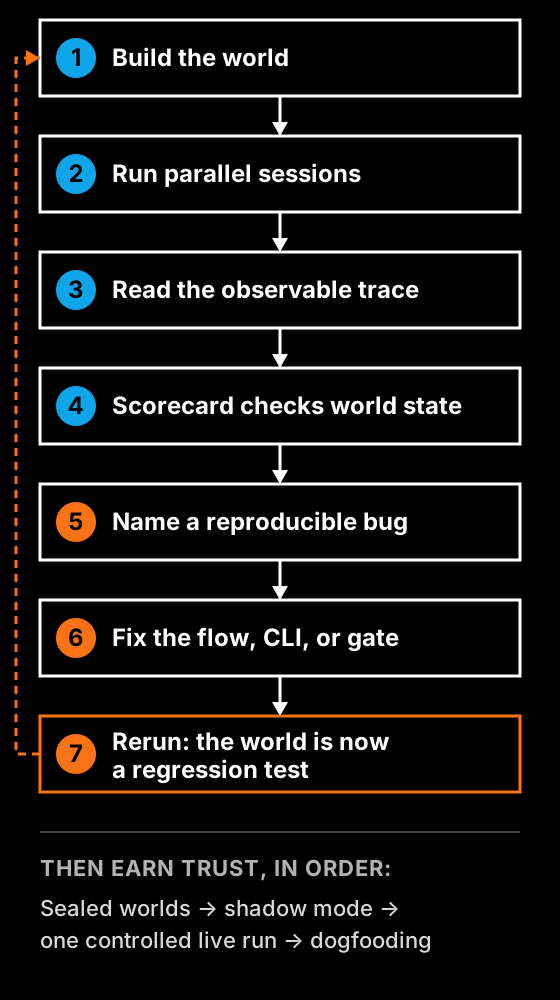
In practice: create a world, reproduce a failure, name the bug, change the flow or the CLI or the gate, rerun the same worlds, and keep them forever as regression tests. This lab established detection and hardened the evaluator. A frozen, prespecified rerun after an agent or flow intervention remains for a future cycle, and until it runs, there is no improvement percentage to report.
The honest boundary
A sealed world is one the tuning process never touches, so it stays an honest exam rather than becoming training data. None of my current suites qualifies: the compound suite had prior exposure, and the core corpus informed the fixes. The trust ladder, in order, with no skipping: paired synthetic worlds for diagnosis → compound worlds for realism → a genuinely fresh sealed suite → shadow mode on real inputs with no actions → one controlled live run behind a human gate → gradual dogfooding.
So here is exactly what this study shows. On one fixed, authored corpus of structured outreach decisions, action-only grading missed many proposal-contract failures that an external deterministic checker caught, and attacking the checker made detection sharper. That is detection and evaluator hardening: not measured agent improvement, not real-world prevalence, not general reliability or production readiness. A good score, when I earn one, will mean the agent passed the worlds I thought to build. Nothing more.
What the worlds give you is more modest and more valuable than a launch signal: every failure they surface is one that didn’t happen to a real person. Good simulation does not make the agent look capable. It makes failure legible, reproducible, and fixable.